Innovating Rock Drilling Solutions
Choosing the Right Drill Bit for Rock Types: Why It Matters in Drilling Operations
Selecting the correct drill bit for the specific rock type is one of the most crucial decisions in any drilling operation. Using the wrong bit can significantly reduce the rate of penetration (ROP), increase operational costs, and cause premature bit failure. It can also lead to excessive wear on drilling equipment, unplanned downtime, hole deviation, and even tool jamming.
To optimize drilling performance, extend equipment life, and ensure cost efficiency, it's essential to match your drill bit to the geological formation. Whether you're drilling through soft sedimentary rock or hard crystalline formations, using the right bit can make a substantial difference.
At Diamond rock tools, we tailor the bit to your requirement by matching the steel, the carbide and the bit design to give you the best performance at a very affordable price.


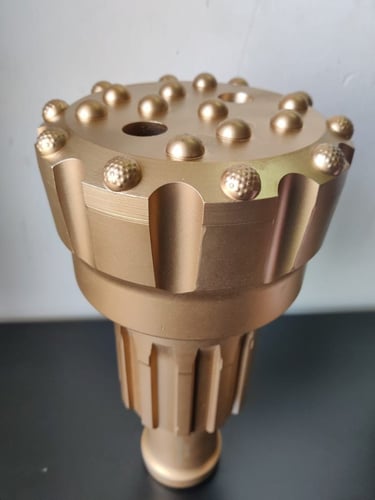
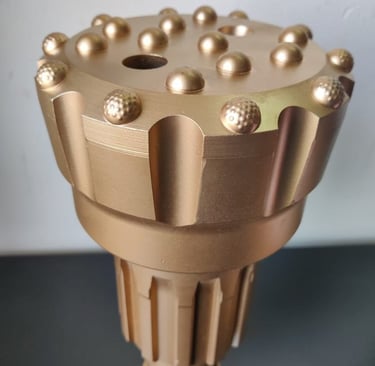
Common Challenges in Rock Drilling — And How the Right Tools Can Solve Them
1. Short Bit Life in Hard or Abrasive Rock
Issue: Bits wear out quickly in granite, quartzite, or magnetite formations.
Impact: Frequent tool changes slow production and drive up maintenance costs.
2. Hole Deviation & Poor Accuracy
Issue: Misaligned blast holes lead to poor fragmentation and reduced ore recovery.
Cause: Wrong bit selection, poor collaring technique, or drill rod bending.
3. Tool Jamming & Stuck Bits
Issue: Bits get jammed in fractured, clay-filled, or mixed formations.
Impact: Leads to costly downtime and time-consuming fishing operations.
4. Premature Bit Failure
Issue: Bits fail early due to thermal cracking, over-speeding, or poor flushing.
Impact: Cracked carbide buttons and failed shank adapters reduce drilling efficiency.
5. Flushing Problems
Issue: Dust and rock chips aren’t cleared effectively.
Cause: Insufficient air/water supply or poor bit design.
Impact: Leads to excessive wear, overheating, and bit binding.
6. Low Penetration Rate (m/hr)
Issue: Slow drilling directly affects daily meterage and project timelines.
Cause: Dull bits, incorrect bit type, or improper drilling parameters.
7. Frequent Re-Drilling
Issue: Worn-out bits or deviated holes force operators to re-drill.
Impact: Increases fuel use, labor costs, and rod wear.
8. Tool-Rig Mismatch
Issue: Using the wrong drilling system — for example, top hammer bits on a rig better suited for DTH drilling in deep, hard rock.
Impact: Reduces efficiency and tool lifespan.
9. Unreliable Suppliers & Spare Part Gaps
Issue: Delayed deliveries, poor backup support, or incompatible thread types.
Impact: Creates rig downtime and production loss.
Value Diamond Rock Tools Offers:
Bit Optimization & Selection Support
Choosing the right drilling tools can dramatically improve performance and cost-efficiency.
Expert selection should consider:
Bits as per rock hardness
Bits which handles unknown fracture patterns and formation type
Bits which maintain uniform Hole depth and diameter
Rig type (pneumatic, hydraulic, rotary, DTH, or top hammer)
Technical Support & On-Site Assistance
Comprehensive technical services help reduce downtime and improve drilling performance:
Bit regrinding and re-tipping programs
Emergency spares for critical sizes (e.g., 102 mm / 115 mm DTH, T45 rods)
On-call technical support during major drilling phases